

What Credit Score Do You Need to Finance a Chevy?
If you are shopping for a new or used Chevrolet, you may wonder whether your credit score is high enough to qualify for financing. The short answer is that there is no single minimum credit score required to finance a Chevy. Approval depends on the lender, the vehicle, your income, existing debts, down payment, credit history, and other financial factors.
Although a higher credit score can help you qualify for more competitive rates and terms, buyers across a wide range of credit profiles may have financing options. The finance team at Woodhouse Chevrolet Omaha can help you explore available opportunities based on your individual situation.
Is There a Minimum Credit Score to Finance a Chevy?
Chevrolet dealerships work with lenders that establish their own credit requirements. As a result, one lender may approve an application that another lender does not.
A credit score of approximately 660 or higher may provide access to a broader selection of financing opportunities, while scores above 700 may help borrowers qualify for more favorable terms. These numbers are general guidelines—not approval thresholds or guarantees.
Buyers with scores below 660 may still qualify for financing. However, they could encounter:
- Higher interest rates
- A larger down-payment requirement
- A more limited selection of loan terms
- A lower approved loan amount
- A request for a qualified co-signer
Your credit score is only one part of the application. According to the Consumer Financial Protection Bureau, lenders may also evaluate income, debts, down payment, loan amount, term length, and whether the vehicle is new or used.
How Credit Scores May Affect Chevy Financing
Credit-score ranges can help you understand how lenders may view an application, but the exact categories and terms vary.
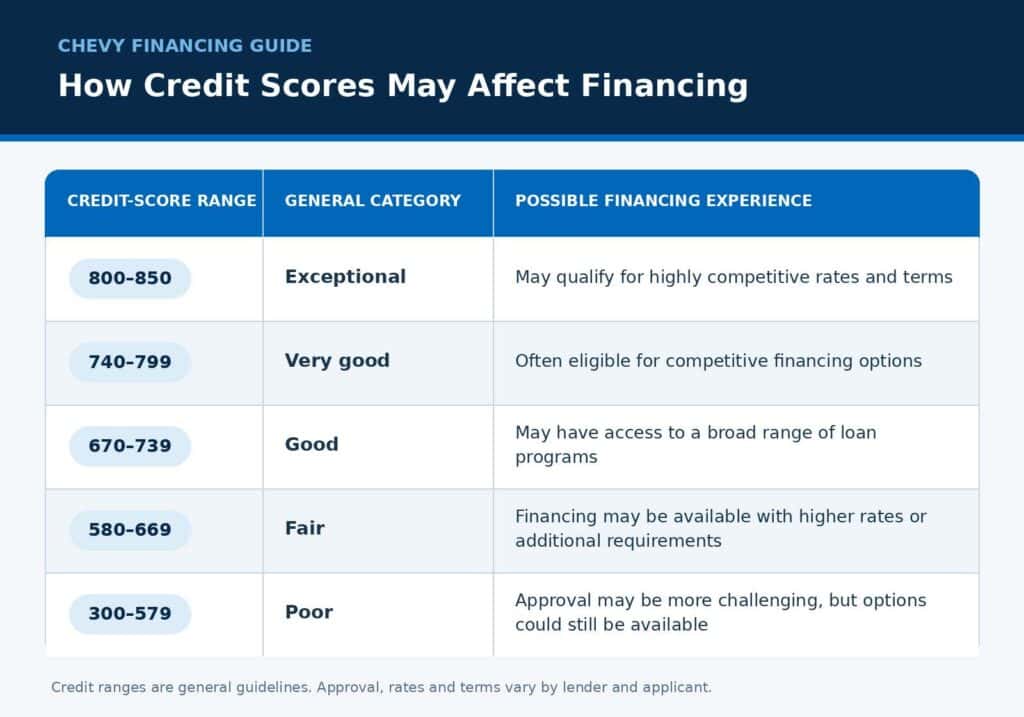
These ranges are educational guidelines rather than Chevrolet-specific lending standards. Lenders may use different scoring models, so the score reviewed during an application may not match the one shown by a consumer credit-monitoring service.
Can You Finance a Chevy With Bad Credit?
It may be possible to finance a Chevrolet with bad credit. A low score does not necessarily result in an automatic denial, especially if the rest of your application demonstrates that you can reasonably manage the loan.
Factors that may strengthen an application include:
- Stable and verifiable income
- Consistent employment history
- A manageable debt-to-income ratio
- A meaningful down payment
- Positive recent payment history
- An affordable vehicle selection
- A qualified co-signer or co-borrower
The available rate and terms will depend on the lender’s review. It is important to consider the total amount financed, annual percentage rate, loan length, and overall borrowing cost—not just the monthly payment.
Can You Finance a Chevy With No Credit History?
First-time buyers and customers with limited credit histories may still have financing opportunities. Having no credit is different from having poor credit: it means lenders have less information available to evaluate how you have managed borrowed money.
You may improve your chances by providing:
- Proof of steady income
- Proof of residence
- A larger down payment
- Employment information
- Personal or professional references, if requested
- A qualified co-signer
Choosing a Chevy that comfortably fits your budget can also make an application more attractive to a lender.
What Else Do Chevy Lenders Consider?
While your credit score is important, lenders typically look at your complete financial profile.
Income and employment
Lenders generally want to confirm that you have enough reliable income to cover the proposed payment and your other financial obligations.
Debt-to-income ratio
Your debt-to-income ratio compares your monthly debt payments with your gross monthly income. A lower ratio may indicate that you have more room in your budget for an auto payment.
Down payment
A larger down payment reduces the amount you need to finance. It may also lower your monthly payment and demonstrate a greater financial commitment to the purchase.
Loan term
A longer term can reduce the monthly payment, but it may increase the total interest paid over the life of the loan. Compare both the monthly cost and the total repayment amount.
Vehicle selection
The price, age, mileage, and condition of the Chevy you select may influence the financing options available. New and used vehicles can also have different lending requirements.
Credit history
Lenders may review more than the numerical score. Your payment history, outstanding balances, recent applications, length of credit history, and previous auto loans can all affect the decision.
Does Financing a New or Used Chevy Require Better Credit?
Neither new nor used Chevrolet financing has one universal credit requirement. However, the offers available for each type of vehicle can differ.
New Chevy models may be eligible for manufacturer-supported financing programs, but the most competitive promotional rates are typically reserved for well-qualified buyers. Used vehicles may provide a lower purchase price, although rates can vary based on the model year, mileage, loan term, and lender.
Compare the following before deciding:
- Vehicle price
- Required down payment
- Interest rate and APR
- Monthly payment
- Loan length
- Total amount paid
- Warranty coverage
- Expected ownership costs
How Can You Improve Your Chances of Chevy Financing Approval?
Taking a few steps before applying may help you find better financing terms.
1. Review your credit reports
Check your reports for incorrect account balances, unfamiliar accounts, or payment errors. Disputing inaccurate information may improve the accuracy of your credit profile.
2. Make payments on time
Payment history is an important part of most credit-scoring models. Continue making credit-card, loan, and other payments by their due dates.
3. Reduce outstanding balances
Lower credit-card balances can improve your credit utilization and reduce your monthly debt obligations.
4. Save for a down payment
Putting more money down can reduce the amount financed, the monthly payment, and potentially the lender’s risk.
5. Select a realistic price range
Estimate what you can comfortably afford before selecting a vehicle. Include insurance, fuel, maintenance, taxes, fees, and other ownership expenses in your budget.
6. Consider a co-signer carefully
A qualified co-signer may help a buyer with limited or challenged credit, but that person becomes legally responsible for the debt if payments are missed.
7. Explore prequalification
Prequalification can provide an initial idea of potential options before completing a full application. For example, GM Financial’s prequalification process uses a soft credit inquiry that does not affect the applicant’s credit score. Prequalification is not a final approval, and completing a credit application may require a hard inquiry.
Will Shopping for an Auto Loan Hurt Your Credit?
Applying for financing can result in a hard credit inquiry. However, credit-scoring models may group multiple auto-loan inquiries made during a concentrated shopping period as one inquiry for scoring purposes.
The CFPB recommends keeping loan comparisons within approximately 14 to 45 days, depending on the scoring model. This allows you to compare offers while potentially limiting the effect of multiple inquiries. You can learn more through the CFPB’s auto-loan shopping guidance.
Explore Chevy Financing in Omaha
You do not need perfect credit to begin exploring Chevrolet financing. Whether you have excellent credit, are rebuilding your credit, or are purchasing your first vehicle, the next step is to review your budget and available options.
The finance professionals at Woodhouse Chevrolet Omaha can help you:
- Explore available loan programs
- Compare new and used Chevy financing
- Estimate your monthly payment
- Include a trade-in in your purchase
- Complete a secure financing application
- Find a Chevy that fits your needs and budget
Browse the Chevy inventory at Woodhouse Chevrolet Omaha and contact the finance department to learn more. All financing is subject to lender approval, program requirements, vehicle eligibility, and applicable terms.
Frequently Asked Questions
What is a good credit score for a Chevy loan?
A score of 670 or higher is generally considered good under common consumer credit ranges and may provide access to more financing choices. However, lenders use different requirements, and a good score does not guarantee approval or a specific interest rate.
Can I finance a Chevy with a 600 credit score?
Financing may be available with a 600 credit score. The lender will also consider your income, debts, down payment, loan amount, employment history, and recent credit activity. Rates and terms may be less favorable than those available to applicants with stronger credit.
Can I get a Chevy with a 500 credit score?
It may be possible, but options are likely to be more limited. A larger down payment, lower-priced vehicle, stable income, or qualified co-signer could strengthen the application. Approval and terms depend entirely on the lender.
What credit score is needed for zero-percent Chevy financing?
Promotional zero-percent financing, when available, is generally limited to well-qualified buyers and eligible models. The required credit profile, term, participating vehicles, and program dates can vary. Not every applicant or Chevy model will qualify.
How much should I put down on a Chevy?
There is no required amount that applies to every purchase. A larger down payment can reduce the loan balance and monthly payment, but you should avoid using money needed for emergencies or other essential expenses.
Can a trade-in help me qualify for financing?
Trade-in equity can function similarly to a down payment by reducing the amount you need to finance. If you owe more than the trade-in is worth, the negative equity may be included in the new loan and increase its cost, subject to lender approval.
0 comment(s) so far on What Credit Score Do You Need to Finance a Chevy?